EVEREST 4.0: what shipped
2026-07-27 · AnimatedGTVR
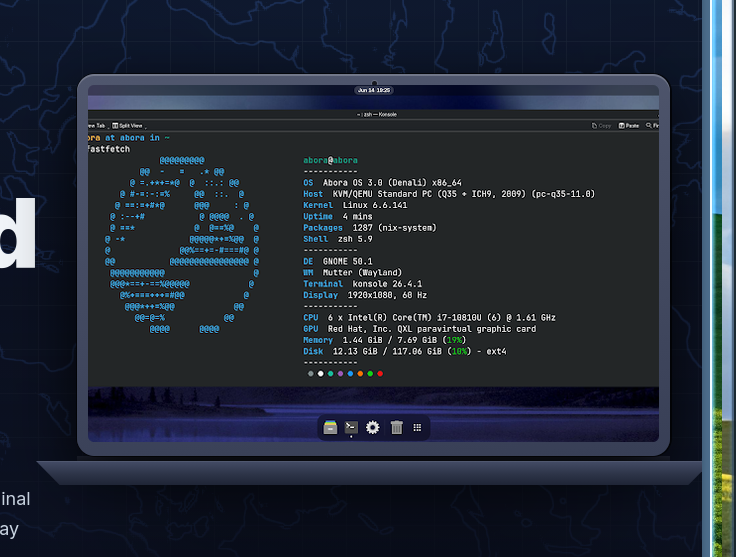
This is the stable Denali foundation that Everest builds on: a working Abora desktop, recognizable tooling, and the system identity that carried the project into v4.
EVEREST 4.0 is the current alpha release. This article explains what shipped in the 2026.07.01 build and how it builds on the Denali foundation.
The multi-edition ISO thing was the first real decision I had to make. Up to 3.14 there was just one ISO, general purpose, pick your desktop from a list of 23 at install time. That works fine but it means everyone downloads the same several-gigabyte image whether they want GNOME or a tiling WM or nothing at all. So now there's five: Cosmic, Hyprland, GNOME, KDE, and Other. Every edition still installs the full desktop matrix, all 23 profiles are still there, the edition just decides what the live session defaults to and what the installer leads with. If you picked the wrong one it doesn't matter, you can still install any of the others.
GPU driver support was the other big one. Before this, NVIDIA hardware just got whatever NixOS defaults to, which is usually not what you want and definitely not something a new user should have to go figure out on their own. Now there's an actual abora.gpu option, the installer runs lspci and offers you a real choice, and NVIDIA cards default to nouveau specifically because it doesn't need you to accept a license just to boot into a desktop. If you want the proprietary driver or the newer open kernel modules, those are right there too, just not the default. AMD and Intel already worked out of the box through the kernel's own drivers, this mostly just makes that visible in abora config instead of being invisible.
ANIX v2 is the part I'm actually most proud of, even though it's the least visible if you never touch it. ANIX used to only understand its own little command language. Now it can read MKO (from the MAKO project) or ModuCPP too, and all three get compiled down into the same Plan JSON before anything actually touches your system. That means anix diff-plan works no matter which language you wrote your config in, and it'll tell you ADD, CHANGE, or SAME for every single setting before you apply anything. I spent a stupid amount of time making sure every one of those language adapters produces output that's genuinely interchangeable, not just superficially similar, because the whole point falls apart if MKO and ModuCPP configs behave differently once they hit the plan engine.
We also shipped the first two real GUI apps: a welcome screen and a settings editor. Both are just GTK4/libadwaita wrappers around commands that already existed, abora welcome and abora config specifically. I was pretty firm about that while building them, nothing the GUI does is exclusive to the GUI. If you never open a graphical window in your life you lose literally nothing. I know plenty of people who install Abora specifically because it doesn't try to hide the terminal from you, and I didn't want the first GUI tools to quietly start walking that back.
Somewhere in testing I also found a Wi-Fi bug that had apparently been sitting in the live ISO profile for a while. A setting meant to disable wireless during install was actually blocking wpa_supplicant from ever registering itself over D-Bus, so some cards would just sit at unavailable no matter what you did, with no useful error anywhere. It only affected the live/installer environment, never anything actually installed, but if you hit it during setup it would have looked completely broken. That's fixed now. I also tightened up the installer's disk picker so it can't accidentally offer you your own boot USB as an install target, which is exactly the kind of thing you don't want to find out the hard way.
On the ANIX side specifically, anix package remove had a broken regex that made it a complete no-op, it would print a success message and do nothing. Nobody caught it for a while because the failure mode is just silence, not an error. That's fixed, and while I was in there I made every anix set, apply-plan, and run operation properly atomic and injection-safe. Either the whole plan lands or none of it does, and nothing you type into a value field can break out into raw Nix source anymore.
There's also a small one that's more embarrassing than important: the OS release metadata still said the codename was denali on 4.0 builds, left over from copy-pasting the module when I renamed things. Fixed, it says everest now.
MINT, the Go/Bubble Tea installer front-end some of you have seen mentioned, is built but I've paused wiring it up as the actual default. It's sitting there as a package but abora-install still runs the bash TUI directly. I'd rather ship something that works over something that looks better on paper but isn't finished, so that one's on hold for now, not cancelled.
LTS is still just a maybe. I know I've talked about it before like it was closer than it actually is. The honest version is: it's technically near release-ready, most of what's left is bug fixing rather than new work, but whether it's worth pushing through that last stretch depends on whether anyone would actually run it. It's also drifted later on the roadmap, more of a v5-era thing now than something bolted onto 4.x. There's a quick poll on the LTS page if you want to weigh in, it's not scientific, it's genuinely just me trying to gauge interest before sinking more time into it.
Anyway. Multi-edition ISOs, GPU driver support, ANIX v2, the first GUI tools, and a handful of bugs that needed to die. That's 4.0. Grab it from the downloads page, and if something's broken, abora-support-report or abora-hardware-test --with-report before you file it, it saves both of us time.
Reader reactions
React to this post
Pick one reaction. Choosing another swaps your vote.